

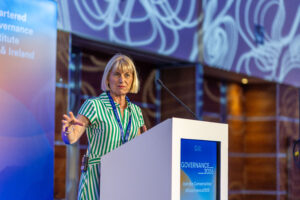
Closing Keynote
Psychological Safety: The Hidden Driver of High‑Quality Governance
This year’s annual CGI conference has explored the systems, structures and pressures shaping governance today, putting a spotlight on AI, ethics, culture, sustainability, risk and resilience. As we close the conference, I would like to bring us back to something profoundly human: the condition that sits beneath every governance framework, every risk process and every board decision.
It is the one thing that determines whether truth travels; whether challenge is welcomed, whether early warnings surface – or stay buried. That one thing is psychological safety; not framed as a soft cultural ideal or as a wellbeing initiative, but as a core governance capability.
Let me start with a thought for everyone in this room:
“If people need courage to speak up, challenge, admit uncertainty or surface risk, the issue is not a lack of courage. The issue is the system that makes courage necessary. And that system is a governance risk.”
Let’s do a quick poll:
POLL QUESTION 1
When something feels unclear or uncomfortable in a workplace meeting, what usually happens, based on your personal experience:
Please pick one of the following options:
- Someone names it directly (that may suggest there is enough trust in the room for candour to happen in real time. That is a strong governance asset)
- Someone asks a careful question (that may be healthy too; careful questions can be a skilful way of creating space for challenge. But it also invites us to ask: how careful do people need to be, and why?)
- People wait until after the meeting (that tells us the real conversation may be happening outside the formal governance space. And when that happens, the meeting may record alignment while the corridor carries the truth.)
- People nod and move on (that is where risk can go underground. Nodding can look like agreement, but sometimes it is confusion, discomfort or self-protection)
- It depends who is in the room (that is perhaps the most important signal of all. It tells us psychological safety is not evenly distributed. Voice is being shaped by power, status or relationships)
So this question is not simply, “Do people speak up?” The real question, from a governance perspective is the “under what conditions, with whom in the room, and at what cost – do people speak up?”
That is why psychological safety matters for governance. It determines whether truth travels in the moment where it can still make a difference.
***************
Let’s demystify what psychological safety is and what it is not.
Psychological safety describes a workplace environment where people can speak up, challenge assumptions and surface risks early. I call this a ‘climate of voice’ – where people lead with enquiry, consult with one another, act with curiosity, and use their voice with confidence and have a sense of agency.
It is where people have the freedom to say, “Something doesn’t feel right here,” without fear of blame, ridicule or career harm. It is a clear manifestation of candour and truth‑telling.
And here’s what it is not:
- It is not being endlessly polite. A boardroom can sound engaged and still be unsafe if every question is approval with a question mark at the end. That is the performance of curiosity, not the practice of it.
- It is not lowering standards, and it is not avoiding accountability.
- Finally, it is not comfort without accountability.
In fact, psychological safety can be, and is often, uncomfortable. It is the willingness to have the difficult conversation, not to avoid it. This is where the courage paradox comes in. As John Amaechi, psychologist and author, writes:
“When courage becomes a prerequisite for doing your job, the hazard is not in the work but in the workplace.”
What does he mean? He means if people need courage to speak truth to power, you don’t have a courage deficit; you actually have a clear leadership signal that something is not right. It is a moment to hold up the mirror and ask: what is really going on here, what can I not see, what am I not hearing?
*******
Governance lives or dies on the quality of information that reaches decision‑makers. And that places governance professionals in a critical position. We are not simply administrators of process. We are stewards of the conditions that allow boards and senior leaders to hear what they need to hear, especially when it is uncomfortable.
If people feel unsafe, three things often happen:
- Risks surface too late.
- Reporting becomes curated.
- Challenge becomes muted.
When that happens, governance structures, however well designed, can become hollow. People may nod when they do not understand, do not agree, or do not feel safe enough to ask questions. In governance, nodding can create the illusion of alignment while hidden risk enters the system.
Questions that are not asked come at a cost. Decisions are made on partial understanding, then executed by people who may not be clear what they are executing. The more questions people do not ask, the more decisions leaders cannot safely rely on.
We’ve seen this in some of the most significant stories of our time.
The Ockenden Report, the independent review of maternity services provided by Nottingham University Hospitals NHS Trust, states that early warnings were present for years, but they were not acted upon. Staff described feeling unheard, intimidated or fearful of repercussions. Risks did not disappear; they went underground.
The Post Office / Horizon case shows what happens when truth cannot travel.
Postmasters raised concerns about discrepancies in the Horizon IT system. Fujitsu engineers identified bugs, errors and defects. Yet the organisational culture was defensive, closed and hostile to challenge.
And finally, the recent KPMG Australia whistleblower case gives us the same lesson in corporate form: this is an example of how a speak-up channel is not the same as speak-up safety. This is not a case where concerns were absent. It appears to be a case where issues were raised, but not effectively heard (investigated) or acted on.
The lesson is simple: the real culture of an organisation is revealed by what happens when someone raises the uncomfortable truth. What connects these three examples is not sector, size or complexity. But there is a pattern: warning signals existed, but the system did not make it safe or valuable for truth to travel.
When people fear repercussions, truth cannot travel. And when truth cannot travel, governance collapses. This is how fear shuts down governance, and there is science behind this.
******************
When people feel unsafe – when they anticipate blame, judgement or humiliation – the brain triggers a threat response or what neuroscientists describe as an amygdala hijack.
The amygdala, our brain’s threat detector, sounds the alarm. Stress hormones flood the body. The nervous system prepares us to fight, flee or freeze. And in that moment, the prefrontal cortex – the part of the brain we rely on for judgement, ethical reasoning, perspective-taking and considered decision-making – becomes less available.
In other words, fear narrows the mind. It protects us, but it does not help us govern well. In threat mode, the capabilities that governance relies on, such as judgement, ethical reasoning, creativity, perspective-taking and challenge, become harder to access.
This is why psychological safety is not a nice-to-have. It is a risk-management mechanism. We do not want people wearing emotional PPE or body armour just to get through a meeting, because then they are slower, more cautious and far less likely to surface the risks leaders most need to hear.
What stops psychological safety from taking root and encourages body armour to be the norm?
- Fear of being wrong
- Rewarding certainty over curiosity
- Over‑reliance on process
- Cultural distance between boards and the organisation – “mind the gap”
And as Horizon showed us, fear of blame can become institutionalised. It can continue to shape and inform behaviour long after the original decision‑makers have moved on. Horizon is not only a technology failure. It is a governance failure because the system rejected the very information that should have corrected it.
****************
What are some practical ways to build psychological safety?
Three things to focus on:
- Ask better questions
- Set explicit norms for challenge.
- Ask: “What are we not seeing?” and “Where might we be nodding rather than understanding?”
- Reward the person who raises the uncomfortable truth, not only the person who presents the polished narrative.
- Reward early warning
- Create rituals of transparency: early-warning dashboards, culture indicators and heat maps.
- Treat more information as intelligence, not inconvenience.
- Make truth visible to the board
Governance professionals have a unique vantage point – you see across the organisation, and you understand risk, behaviour, culture and process.
- Ask the question no one else is asking.
- Name the tension in the room.
- Clarify assumptions and connect the dots others miss.
- Model curiosity and humility.
For governance professionals, this matters because you sit at the junction between formal process and lived reality. You see what is recorded in the minutes, but you may also sense what was not said. You see what reaches the board, but you may also notice what has been softened, delayed or stripped of context. That is why your role is not only to support governance process, but to protect governance truth.
From a leadership perspective, we need to move beyond seeing psychological safety as an initiative. It is a leadership discipline and a mindset. It requires:
- Clarity
- Consistency
- Courage
And it delivers:
- Better decisions
- Stronger ethics
- Higher performance
- Greater resilience
I’m going to start to wrap up by asking you to identify one clear action point after today.
POLL QUESTION 2
What is the one governance practice you will strengthen after today?
Please pick one of the following options:
- Ask more precise questions
- Reward early warning signals and uncomfortable truths
- Test whether speak-up channels feel genuinely safe
- Make culture and conduct signals more visible to the board
- Model curiosity and admit uncertainty more openly
Whatever one you chose, the work begins with making it easier for truth to travel and a climate of voice to develop, before risk becomes a crisis.
In summary
Governance excellence is not built on perfect systems. Governance depends on the practice of curiosity: the willingness to ask, “What are we missing?”, “What are we assuming?”, and “Where might we be simply nodding rather than genuinely understanding?”
The best governance questions are not an inconvenience to governance. They are intelligence to inform our decision-making and optimise the choices we make. They disturb the comfort of the current story – and that is precisely why they protect the organisation.
************
My invitation to you is this: use your governance role to make truth easier to hear. Ask the question that tests the assumption. Notice when the room goes quiet. Pay attention to what is said after the meeting. And help your boards understand that silence is not assurance and that psychological safety is a critical governance capability, not a well-being initiative.
Because when truth travels earlier, risk surfaces sooner. And when risk surfaces sooner, governance becomes stronger.
Thank you.